Continue with
A particular kind of quiet that settles over a room with a well-kept aquarium in it.
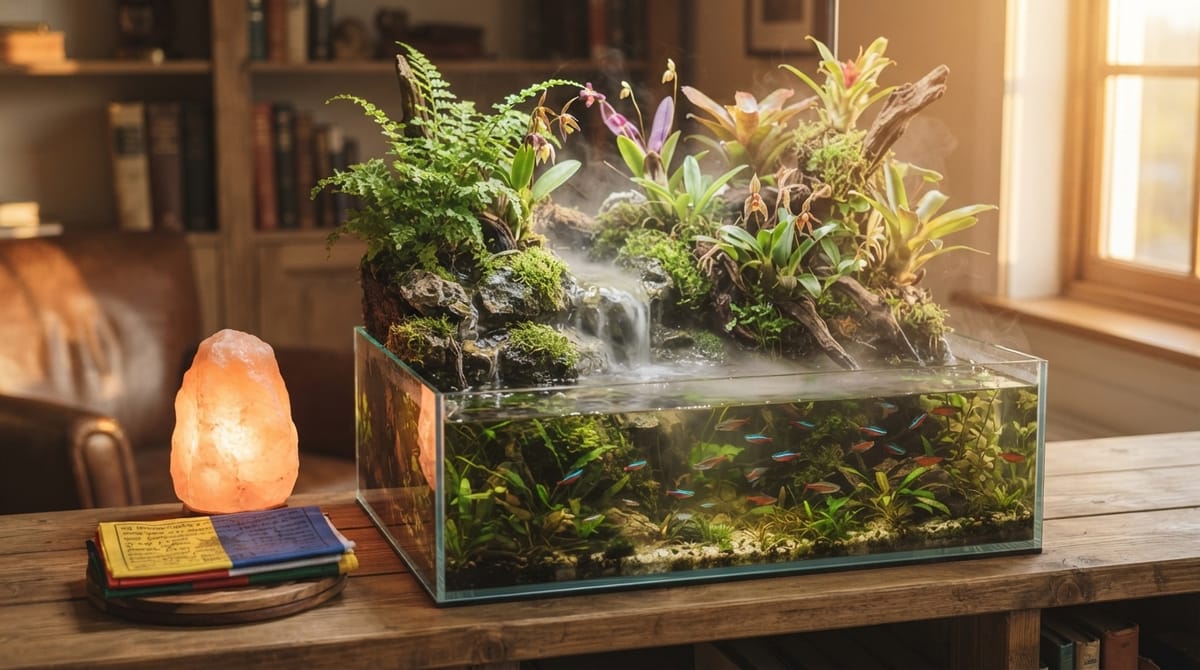
There is a particular kind of quiet that settles over a room with a well-kept aquarium in it. Not silence — there's usually the soft hum of a filter, maybe the trickle of a small waterfall — but a kind of settledness, the sense that something in the room is alive and doesn't need you to do anything except watch. Picture a Betta fish weaving slowly through a stand of Java moss: nothing about that motion is designed to soothe you, and yet it does. For a moment, deadlines and city noise fall away, and there's nothing left to do but be present. That feeling isn't a romantic accident. It sits at the center of a much bigger conversation happening in 2026 about what wellness actually means for ordinary people — a conversation Nepal, in particular, has put at the heart of national policy. Wellness Has Left the Yoga Mat In 2026, the idea of wellness has outgrown the gym and the retreat. It has become infrastructure. Nepal's government has committed to a ten-year National Wellness Tourism Strategy (2026–2035), paired with a five-year action plan, designed to build the country's international identity around Ayurveda, yoga, meditation, spa therapy, and spiritual healing rooted in its biodiversity and cultural heritage. The strategy was formally unveiled on International Wellness Day, April 15, 2026, at a ceremony in Tundikhel, Kathmandu, where Speaker Dol Prasad Aryal told the gathering plainly that wellness is not a luxury but a necessity for a healthy, prosperous, and balanced society. The government has backed that language with money: the 2026/27 federal budget earmarked over Rs. 10.5 billion for the tourism ministry and set aside financial incentives for wellness resorts, hotels, and dedicated meditation centers, with 2027 formally marked as "Nepal Wellness Year" and a national "Arogya Nepal" (Wellness Nepal) marketing campaign due to launch alongside it. That's an ambitious, outward-facing vision — one aimed largely at attracting 10,000+ international wellness tourists a year by 2030. But it raises a quieter, more personal question: what does everyday wellness look like for the person who isn't checking into a Himalayan retreat next month, but who still needs a way to slow their nervous system down on a Tuesday evening in a Kathmandu apartment or a Pokhara flat? The answer may be much smaller — and much closer to hand — than a national tourism strategy. It may be sitting on a shelf, behind glass. Beyond "Fish Keeping": Three Kinds of Miniature Worlds We tend to describe these setups as "fish tanks" or "plant jars," language that reduces something genuinely complex to a chore. Reframing them as small, observable ecosystems changes what they're for. You're not just feeding a fish or misting a fern — you're tending a self-regulating world, and in the process, borrowing a little of its regulation for yourself. Aquariums are the most familiar entry point, but a well-planted tank is really an exercise in balance: nitrogen cycles, light schedules, the slow negotiation between algae and the creatures that graze it. Aquascaping — the deliberate art of arranging plants, rock, and driftwood underwater — turns maintenance into a genuinely creative practice, closer to painting or gardening than to pet care. Terrariums move the medium from water to land and air. A properly sealed terrarium is a small marvel: condensation cycling like weather inside the glass, a self-contained jungle that can run for years off the water it started with, especially once it develops its own "clean-up crew" of springtails and isopods that keep decaying matter in check. Open terrariums trade that near self-sufficiency for more hands-on, tactile care. Paludariums sit between the two — part aquatic, part terrestrial, frequently built around a waterfall or a bog grading into dry land. They're the most demanding of the three builds, requiring real engineering of water flow, ventilation, and a bioactive substrate, but also the most vivid: frogs above the waterline, fish below it, orchids and moss finding their own footholds in the middle. Exhibitors at horticultural shows like the UK's RHS Malvern have highlighted exactly this quality — that paludariums offer a rich, layered sensory experience that makes the mental-health case for bringing nature indoors more viscerally than a houseplant on a windowsill ever could. What the Science Actually Says This isn't only anecdotal. A 2026 study in the Journal of the American Psychiatric Nurses Association — a narrative inquiry into mental health and home aquariums — examined how people living with depression and anxiety experienced aquarium keeping, and found that participants described it as a source of emotional regulation, social connection, and personal growth. People spoke of the practice as a way to reconnect with memory, find a sense of purpose through caregiving for another living thing, and access calm through the creative process of aquascaping itself. That's a meaningfully different finding from generic "nature is good for you" research — it points specifically to caregiving and creative arrangement as the active ingredients, not just passive proximity to water. This lines up with the broader, more established literature on biophilia — the idea, popularized by biologist E.O. Wilson, that humans have an innate, evolved pull toward other living systems. It also connects to attention restoration theory, the well-documented finding that natural, softly varied stimuli (moving water, drifting fish, gently swaying moss) draw on effortless attention and give the brain's more effortful, directed-attention systems a chance to recover — which is a large part of why aquariums have long been fixtures in hospital waiting rooms and dental offices. The Real Benefits A genuinely accessible form of nature-based therapy. Where a wellness retreat or a trek requires time, money, and travel, a tank requires a shelf. The JAPNA study's language — emotional therapy, social connection, personal growth — describes something available at a fraction of the cost of institutional wellness care. Cognitive stimulation, not just calm. Building a paludarium or aquascape involves real problem-solving: balancing lighting, engineering drainage and water flow, choosing a substrate that supports both plant roots and animal welfare. It's a hobby that exercises planning and troubleshooting as much as it soothes. Tangible control and ritual. In a world that can feel unmanageably large, a 20-gallon tank or a terrarium is a system a person can actually understand and influence. Feeding times, water changes, misting schedules become small, dependable anchors in a day. Slower time, absorbed by proximity. A terrarium's growth is measured in months, not minutes. Watching that pace up close tends to recalibrate a person's own relationship with time, in a way that's hard to manufacture through willpower alone. Nature access without space. For people in dense urban housing — increasingly the norm in Kathmandu and Pokhara alike — these ecosystems offer a daily dose of "nature escape" that doesn't depend on having a garden or a balcony. The Honest Costs None of this is a wellness cure-all, and it's worth being direct about where it can go wrong. The learning curve is real, and early failure is common. New aquarists lose fish to unstable water chemistry; new terrarium builders lose plants to mold or excess condensation in a badly balanced closed system. For someone seeking calm, an early die-off can produce the opposite of the intended effect — guilt and discouragement instead of peace. Cost and complexity creep, especially with paludariums. Adjustable ventilation, waterproof basins, misting systems, specialized lighting — a paludarium can become expensive and demanding fast, turning a stress-reducing hobby into a source of low-grade stress if approached without realistic expectations. Ongoing responsibility, not a "set and forget" purchase. Terrariums can be largely self-sustaining, but aquariums need regular water changes, and paludariums — with three distinct zones (terrestrial, riparian, aquatic) — demand precise, continuous control over temperature and humidity for the animals inside them to actually thrive. It can become another screen-adjacent obsession. Aquascaping and terrarium communities online are genuinely vibrant, but also comparison-heavy. It's entirely possible to trade doom-scrolling for tank-scrolling and lose the present-tense calm that motivated the hobby in the first place. Ethical weight. Fish, shrimp, and amphibians are living creatures with real welfare needs, not decorations. A wellness practice that neglects what's inside the tank is a contradiction worth taking seriously — and it's a large part of why Nepal's own wellness strategy insists on licensing, hygiene protocols, and trained practitioners even for its human-facing spa and therapy services. The same standard of care is owed to any animal brought into a home ecosystem. The honest takeaway: these ecosystems support wellbeing best when approached slowly and modestly. A small, well-researched tank beats an ambitious, overreaching one almost every time. The Nepal Connection Nepal's national wellness strategy leans on the country's mountains, rivers, and monasteries as sources of what Minister Khadgaraj Poudel has called "spiritual peace and positive energy," well suited to yoga, meditation, and naturopathy. It's also branding trekking routes — including stretches of the Annapurna region — as wellness circuits in their own right, blending the country's adventure-tourism identity with its new health-tourism ambitions. But the underlying logic of that national strategy — that sustained contact with a living, self-regulating natural system does something for the human nervous system that manufactured environments don't — is exactly the logic behind a terrarium on a Kathmandu apartment windowsill. Nepal is scaling that idea up to a national identity, aiming for over 10,000 international wellness visitors a year by 2030. Most of us can only manage it at the scale of a glass tank on a shelf. Both are, in their own way, a bet that wellbeing is built through sustained contact with living systems, not purchased in a single transaction — a philosophy Nepal's own policy documents echo directly in their push to treat mental health as a core part of public health, alongside the expansion of community-based yoga and meditation programs. If "Arogya Nepal" is going to mean something beyond a tourism slogan, it will need a domestic complement — something ordinary citizens in Kathmandu, Pokhara, or Biratnagar can do at home, on an ordinary Tuesday, without a plane ticket or a wellness-resort membership. A ten-gallon aquarium or a moss terrarium is about as close to that as a household object gets. What an Individual Can Actually Do Wellness at the scale of a single evening doesn't require a national strategy. A few concrete starting points: Start smaller than you want to. A nano aquarium with a few hardy plants and shrimp, or a simple open terrarium with moss and one or two low-light plants, teaches the fundamentals — patience, observation, the humility of getting water chemistry or moisture wrong — without the cost or heartbreak of a failed paludarium. Build a short daily observation ritual. Even two or three minutes of unhurried attention toward a tank, morning or evening, functions like a brief, low-effort mindfulness practice — no cushion or app required. Let care become a rhythm, not a chore. Fixed days for water changes, feeding, or misting turn a hobby into a dependable anchor point in the week, which is often more stabilizing than the tank itself. Pair it with other low-tech biophilic habits. A single well-placed houseplant, a short walk without headphones, or even eating one meal a day near a window all reinforce the same nervous-system effect at near-zero cost. Treat animal welfare as part of the practice, not separate from it. Research a species' actual needs before buying it. A wellness hobby that causes suffering to the animal in the tank undercuts its own purpose. Join a local or online community, but set boundaries around it. Aquascaping and terrarium forums are genuinely useful for troubleshooting — but if scrolling comparison photos starts to replace time actually watching your own tank, that's worth noticing. Don't wait for a perfect setup to begin. A single glass jar with moss, a betta bowl, or a small planted tank started this month will teach more than months of researching the "ideal" paludarium never built. None of this replaces professional mental health care where it's needed — a terrarium is not a substitute for therapy, medication, or a doctor's advice, and the JAPNA study itself frames aquarium keeping as a complement to treatment, not a replacement for it. But as a low-cost, daily, homegrown wellness practice, these small ecosystems offer something Nepal's national strategy and a person's own living room have in common: the conviction that slowing down next to something alive is not indulgent. It's necessary.
- By tropicalGharAdmin, 8/25/2026


No Reviews added. Be the first one.